
How Much Does a Wedding Officiant Cost in Florida?
What the big wedding sites leave out from an officiant who has written and led ceremonies in South Florida since 2012.
The short answer
In Florida, a wedding officiant can cost anywhere from under $100 to more than $3,000. Where you fit depends on one question: are you paying someone to sign your license or to create your ceremony?
• Under $100 to $450: A short, standard ceremony. Often a notary or a busy officiant reading a template, sometimes booked for several weddings that day.
• $500 to $1,000: More personalization, usually built from a template, with a meeting or two beforehand.
• $1,000 to $3,000 and up: A ceremony written from scratch around your story, with planning sessions, vow help, rehearsal guidance, professional sound, and an officiant who is there not only for your wedding exclusively, but to support you throughout the process until your marriage certificate is safe in your hands.
The national averages you’ll see online, $260 from The Knot and $300 from WeddingWire, describe the first group. They are accurate averages. However, they are not a measure of what a great ceremony is worth.
Where the $200 to $450 number comes from
Ask the internet what an officiant costs, and you’ll hear the same answer everywhere. WeddingWire says most couples spend $200 to $450, with a national average of $300 (WeddingWire). The Knot puts the average at $260, which it notes is “just a little less than 1%” of a typical wedding budget (The Knot).
I don’t dispute those numbers, but I dispute what couples are led to believe they mean.
An average tells you what most people paid. It doesn’t tell you what they got. Many of the ceremonies behind that average are 15-minute readings from a template, led by someone the couple met once, or never.
In Florida, a notary public can legally marry you (Florida Statute 117.045), so low-cost options are everywhere. That’s a real service, and some couples want exactly that. But when it gets folded into a single “typical” price, every officiant who writes and builds a ceremony from scratch starts out looking overpriced.
The same Knot article says secular officiants charge “$200 to $1,000+, depending on services.” WeddingWire lists what a professional fee covers: at least three to four hours of preparation, vow-writing help, license filing, rehearsal time, sound equipment, and the ordinary costs of running a business. The sites know the work exists. The summary number just doesn’t show it.
What goes into a ceremony before you ever see it
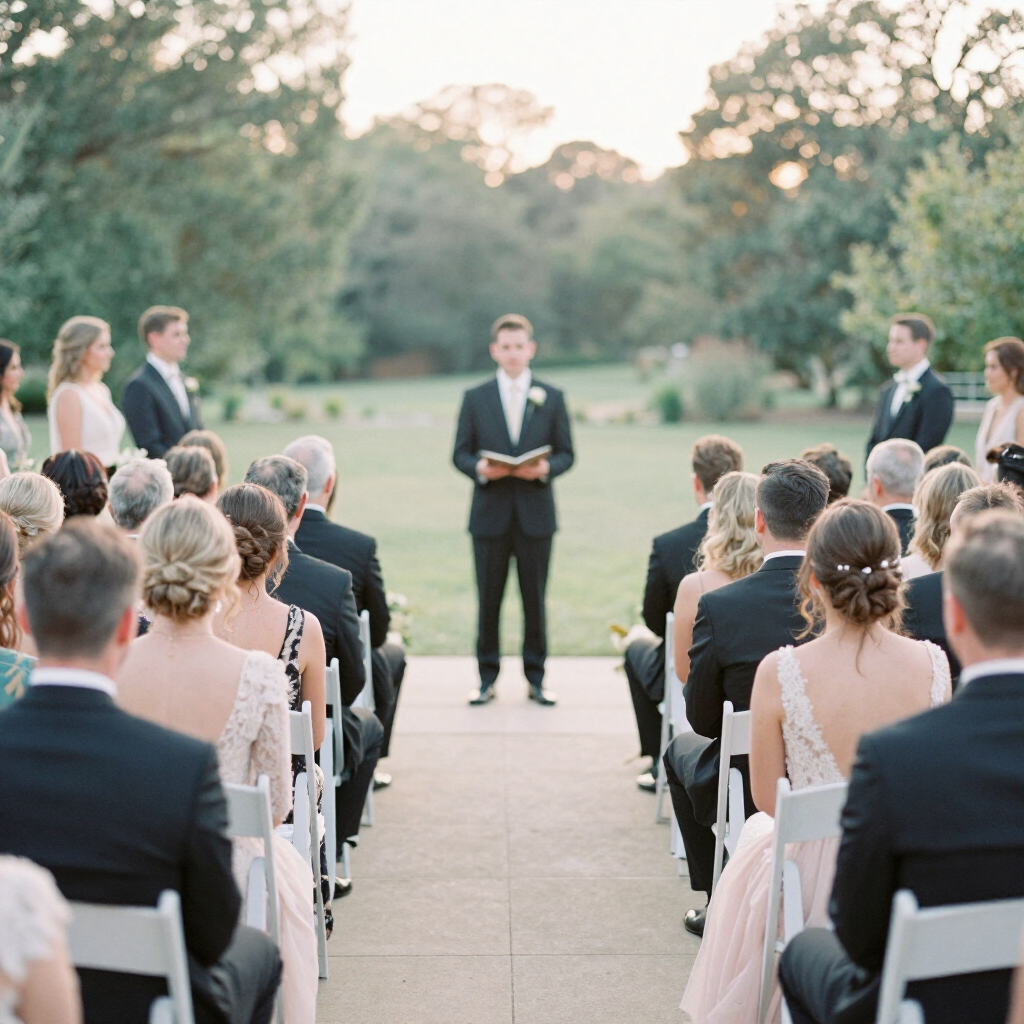
Couples see 20 minutes at the altar, but here is what happens before, during, and after those 20 minutes when a ceremony is written from scratch.
Before the wedding
• A consultation to learn who you are and what you want the day to feel like
• A private questionnaire for each partner, so I get two honest versions of your story
• Reading every answer, more than once, and finding the thread that ties you together
• Writing the ceremony from a blank page, then revising it with you until every line feels perfect
• Helping each of you with vows, separately, so they stay a surprise but remain balanced
• Planning the music cues, the processional order, and what everyone involved will do
On the wedding day
• Arriving early to ensure parents and the wedding party feel comfortable with their roles
• Setting up and testing sound so every guest can hear
• Working with your planner, photographer, and DJ so nothing collides
• Leading the ceremony with the calm confidence of someone who has done it hundreds of times
After the wedding
• Completing and shipping your marriage license with over-night, express delivery
In my practice, that adds up to roughly 40+ hours for a single ceremony. Divide $300 by that number. That’s the hourly rate the internet suggests for the person who legally marries you and holds the most important 20 minutes of the day. (Here, so you don’t have to whip out the calculator: it’s about $7.50 an hour, which is less than Florida’s minimum wage.) That’s the hourly rate the internet suggests for the person who legally marries you and holds the most important 20 minutes of the day.
This is also why so many officiants book two or three weddings in one day. Very few people can earn a living otherwise. Couples feel the result: an officiant watching the clock, a script they’ve heard before, a rushed ceremony, and an early goodbye, so they can get to their next wedding on time.
How officiant fees compare with other wedding vendors
The average American wedding cost $34,200 in 2025, according to The Knot’s 2026 Real Weddings Study of more than 10,000 couples (The Knot). Here is how the officiant compares with other vendors in that same study.
| Vendor | Average cost |
|---|---|
| Photographer | $3,000 |
| Florist | $2,800 |
| Videographer | $2,300 |
| Planner | $2,100 |
| DJ | $1,800 |
| Wedding cake | $540 |
| Officiant | $260 |
The average couple spends about twice as much on their cake as on the person who marries them.
I’m not knocking any of those vendors. I’ve worked beside them for years, and they earn their fees. But think about what each one actually captures. The photographer captures your emotions. The videographer records them. The florist frames them. The DJ cues the music to enhance them. Every one of those vendors is building around a moment the officiant creates.
Without the ceremony, there’s nothing to photograph but a party.
What you get at each price level
Price alone won’t tell you much. Ask what the fee includes. Here’s what each range usually looks like.
| Under $450 | $500 to $1,000 | $1,000 and up | |
|---|---|---|---|
| Ceremony script | Template or standard script | Template with personal details added | Written from scratch around your story |
| Time with you beforehand | Phone call or none | One or two meetings | Questionnaires, consultations, and unlimited revisions |
| Vow help | Rarely | Sometimes | Usually included or offered |
| Rehearsal guidance | Extra fee or none | Sometimes | Included or offered |
| Sound system | Rarely | Sometimes | Professional microphones and sound system |
| Weddings that day | Often several | Sometimes two | Yours only |
| Backup officiant | Rarely | Sometimes | Built in |
These ranges are general, and every officiant is different. Use the table as a list of questions to ask, whoever you’re interviewing.
The ceremony is the reason for everything else
Take away the flowers, and you still have a wedding. Take away the band, the cake, even the venue, and you still have a wedding. Take away the ceremony, and you have a party.
The ceremony is the only part of the day that actually marries you. It’s the moment your grandmother leans forward in her chair. It’s when your parents bless your marriage out loud, instead of just walking you down the aisle. It’s when your whole family, asked if they’ll support your marriage, answers together with a loud “We do!” It’s the kiss that lands just at the right time of your recessional song and the cheer that follows.
Those moments don’t happen by accident. Someone has to learn your story, write it, plan it, and lead a room full of people through it with confidence. That’s the officiant’s job.
Couples already sense this. According to The Knot, about two out of three couples now ask a friend or relative to officiate, up from 27% in 2009 (NPR). They want the person at the front of the room to know them, and that instinct is right. The ceremony should be personal. The question is whether anyone has given that friend the words, and the preparation, to actually deliver it well.
To my fellow officiants
If you’ve ever sent a quote and watched a couple go quiet, this part is for you.
A website average doesn’t set your worth. It’s a number built from what people paid and not from what the work requires. Every other vendor in this industry prices by their craft, their time, and their results. We get to do the same.
So here’s what I’ve learned in more than a decade of doing this work:
1. Show the work. Couples can’t value what they can’t see. Tell them about the questionnaires, the drafts, the rehearsal, the license. Put it on your website and in your pricing guide.
2. Stop apologizing for your price. State it plainly and explain what it includes. Confidence reads as quality.
3. Protect your craft. If you’re booking three weddings a day to make rent, your couples feel it, and so do you. Charging enough to give each couple your full attention is good for them, too.
4. Raise the standard together. Every officiant who writes an original ceremony, shows up early, and stays present makes it easier for the next couple to understand what this role is worth.
We are the people who turn a celebration into a marriage. It’s time the industry priced us that way, and it starts with how we value ourselves.
I’m working on new ways to help officiants write stronger ceremonies and charge what that work deserves. If that interests you, let’s connect: Cynthia@CeremoniesWithCynthia.com
Frequently asked questions
How much should I pay a wedding officiant in Florida?
It depends on what you want. A short, standard ceremony is often under $450. A ceremony written from scratch, with planning, rehearsal guidance, and professional sound, usually costs $1,000 to $3,000 or more. Compare what’s included, not just the price.
Why do some officiants charge so much more than the average?
Because they’re doing more work. A custom ceremony can take many hours of interviews, writing, and revisions before the wedding day, plus rehearsal, sound setup, and license filing. Officiants who book one wedding a day also need to charge enough to make that possible.
Can a notary marry us in Florida?
Yes. Florida law allows notaries public to perform marriage ceremonies (Florida Statute 117.045). It’s a good fit for couples who want a legal ceremony that they do not want personalized.
Do you tip a wedding officiant?
A tip is optional and separate from the officiant’s fee. The Knot suggests it as a way to thank an officiant who went above and beyond (The Knot).
Can a friend officiate our wedding in Florida?
Florida allows ordained ministers and clergy, judicial officers, circuit court clerks, and notaries to perform marriages (Florida Statute 741.07). Many friends become ordained online for the occasion.
What if a friend is officiating, but we still want a professional ceremony?
You can hire a professional to write the ceremony and coach your friend to deliver it. You get someone you love at the front of the room and a ceremony that sounds professionally flawless. Ceremonies with Cynthia offers this, so reach out Cynthia@CeremoniesWithCynthia.com to learn more.
Sources
• Haight, Cathryn. Wedding officiant cost guide. The Knot, updated May 6, 2026. theknot.com
• Average wedding cost. The Knot, 2026 Real Weddings Study. theknot.com
• Wedding officiant cost. WeddingWire. weddingwire.com
• “Amateurs Now Conduct Most Weddings. Here Is Some Basic Advice.” NPR, June 27, 2026. wunc.org
• Florida Statutes §117.045, Marriages. flsenate.gov
Photos credited to Cheryl & Jay Photography